This page brings together the analyses and contributions that Agency for Peacebuilding (AP) has produced on peace mediation, discussed in particular during the Bologna Peacebuilding Forum of May 2024 entitled “Peace Mediation at a crossroads”.
The theme
Peace mediation has changed profoundly over the last two decades in terms of actors, approaches and legitimacy. While the role and influence of the United Nations have declined, some regional bodies, such as the Arab League and the European Union, have gained more space. In addition, a range of state actors, such as Turkey or China, have sought recognition as credible and effective peace mediators, broadening a group that in the past was largely made up of European states such as Norway and Switzerland.
At the same time, peace mediation has increasingly become a profession in its own right, with its own diverse community of researchers, experts and practitioners. Various forms of mediation support guide and sustain the work of mediators, while a number of states and regional organisations increasingly rely on specialised mediation support staff and services, run mediation-oriented training and feed into mediation rosters.
The Forum
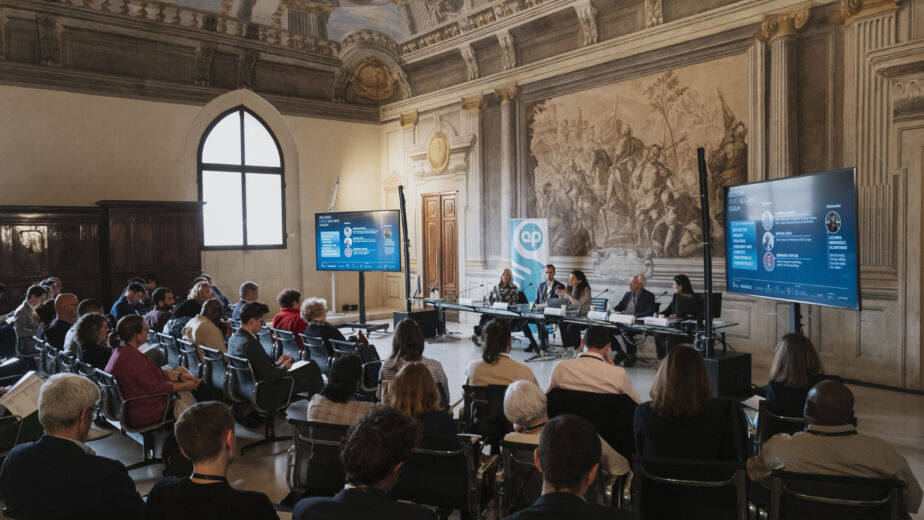
In this context, the Bologna Peacebuilding Forum (BPF), now in its sixth edition, offered a space to analyse peace mediation and its changing dynamics, with a particular focus on the opportunities offered by inclusive and multi-level mediation.
Peace mediation is usually confidential work, often carried out away from public attention, so the Forum offered a rare opportunity for an open debate involving a wide range of stakeholders.
The BPF consisted of public events with free admission, made possible also thanks to the contribution of our supporters, and advanced training workshops for university students.
The first day featured three public events:
-
- The first event of the morning, at the Biblioteca Salaborsa – conference hall, focused on digital technologies for peace and mediation. In particular, it addressed how technological and digital innovation can help reach marginalised groups in mediation and peace processes. At the same time, this raises some critical issues, which were the subject of dialogue among international experts.
-
- At Palazzo D’Accursio – Cappella Farnese the second event of the day took place, entitled “A world at war: peace mediation and the role of Italy”. During the event, in the presence of city councillor Rita Monticelli, responsible for Human Rights and Interreligious and Intercultural Dialogue, and Amb. Luca Fratini – Ministry of Foreign Affairs and International Cooperation, the research study “Italy and Mediation”was presented. The study discussed the transformation of peace mediation at global level and the role Italy can play in this new scenario.
-
- The day ended with the show “Pace Libera Tutti”, a cultural event held at the Teatro del Baraccano, written and performed by the civic theatre group Fraternal Compagnia, directed by Massimo Machiavelli, with music by Umberto Cavalli. Through comedy, the show spoke about humanity and revealed its peaceful nature, letting reflection grow out of a smile.
The second day was dedicated to the now traditional international conference “Peace Mediation at a Crossroads” at Johns Hopkins University. The four panels, with Italian and international guests, outlined the scenarios and developments peace practitioners are facing, the theme of inclusive mediation and the possible future of peace mediation.
The Forum ended with an advanced training workshop for university students on peace mediation topics, using innovative and engaging methods.
Materials and content
- Event website: Peacebuilding.eu
- Study on Italy’s role in peace mediation, in Italian: “Italia e Mediazione”
- The scientific report of the forum, in English, with the content discussed by the guests of the international conference “Peace mediation at a crossroads”
- Articles related to the themes of the Forum published on HuffPost Italia:
-
- “No step back on women in peace mediation” by Mariachaira Giaccai
- “Peace mediation at a crossroads” by Bernardo Venturi
- “From cyberwar to cyberpeace” by Mikhail Silvestro Sustersic