
From verandas to policy rooms: why peacebuilding needs both sides
IN BRIEF
What happens when an exchange of practices among young peacebuilders exposes a structural imbalance, community engagement on one side, policy advocacy on the other? From the Ugandan practice of community barazas to a new youth-led organisation.
Authors: Sara Buccafusca and Antonitah Amuge
From verandas to policy rooms: why peacebuilding needs both sides
Often, perceptions and culturally-rooted narratives have portrayed young people as victims or perpetrators, not accounting for their constructive roles in society and in the peace and security sector. What gets lost in that narrow framing is a third truth, the one that Resolution 2250 tried to put on record in 2015 after years of advocacy by over 11,000 young people from more than 110 countries. Young people are already building peace. The question is not whether they belong in the room, but how their work on the ground connects to the decisions made far above it.
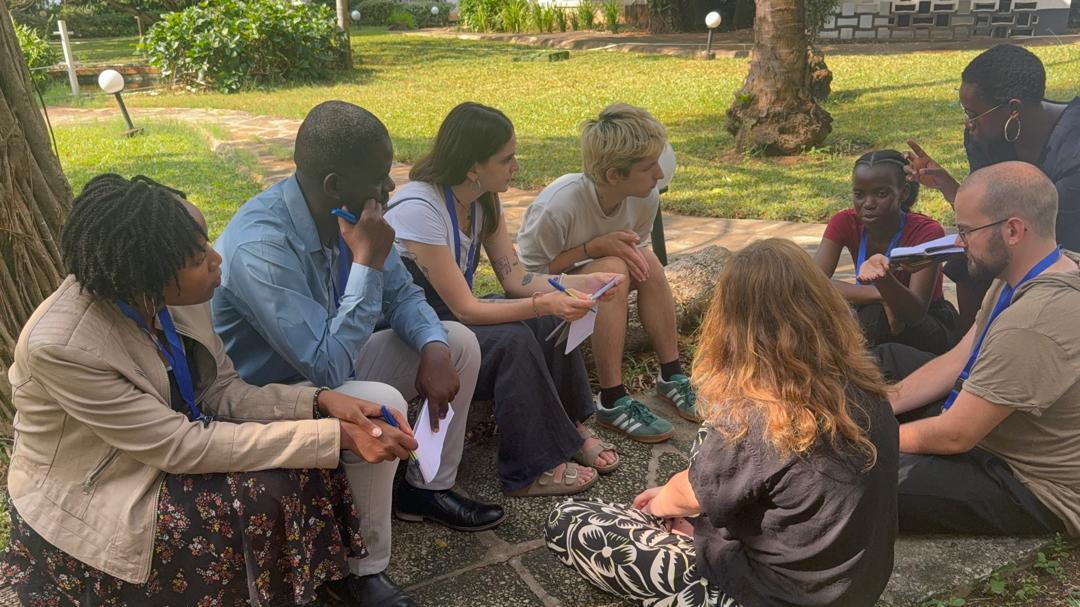
That question followed us to Mombasa, where from 13 to 18 July the Amani Pamoja project brought together 24 young peacebuilding professionals from Kenya, Uganda, Tanzania, Spain, Germany and Italy for a week of exchange. We arrived with our own projects, our own case studies, our own instincts about what peacebuilding looks like. We left with something more useful: a shared picture of where those instincts converge, and where they don’t.
Listening across contexts
During the exchange, each participant presented a practice from their own work, and, divided in smaller groups, we examined it together, not to rank it but to understand why it worked, where it strained, and what made it transferable. It was in this exchange of practices that the connections between our different contexts became visible, and with them, the weaknesses each of us carries into our own peacebuilding efforts.
One of the practices that resonated most was shared by my colleague Antonitah Amuge, who walked us through a practice from Soroti, Eastern Uganda: the community baraza. “Baraza” is a Kiswahili word for “veranda”, and it names something older than the meetings it now describes. In East African tradition, meals, gatherings and conflict resolution happened on the veranda of a family home, and over time the veranda itself came to stand for peace, unity and reconnection. A baraza today gathers hundreds of community members, sometimes over three hundred, to talk through what is affecting them, insecurity among other issues. Ugandan government bodies and civil society organisations use the format for public education as much as for conflict resolution, but its real force lies in what it corrects: the oppression of self-expression that sits at the root of so much escalating violence. People who are heard, and who see their concerns translated into locally tailored solutions, are less likely to feel that violence is the only channel left to them.
Two habits of peacebuilding
Sitting with practices like the baraza alongside the advocacy campaigns and policy briefs coming from the European participants, a pattern became hard to ignore. The East African teams had built their work around sustained community engagement. The European teams had built theirs around influencing policy. Naming this involuntary imbalance that emerged was uncomfortable in a useful way.
As a Ugandan peacebuilder, Amuge names the challenge directly in her own reflection: she explained that translating community work into policy influence is a persistent challenge, one the exchange made harder to avoid rather than easier to solve. Community engagement without a path to policy risks leaving unfair or biased decisions in place, made by people who were never in the room to hear what barazas hear every week.
But the reverse imbalance is just as real. European peacebuilding cannot only aim at the global stage while treating grassroots relationships as someone else’s task. We cannot claim to be working for world peace while failing to hold a single community together at home. In order to receive positive results in global peacebuilding efforts, it is paramount that equal efforts be put into promoting peace from grassroot levels to the global stage. Working toward peace is a collective responsibility, and every piece must be in place to complete the puzzle.
For Amuge, that discomfort turned into action. Since Mombasa, she has started registering a youth initiative, an organisation led by and focused on young people, built to give them a platform not only to speak but to move from influence within their own communities toward a real presence in national policy. She is still working out how to bridge that gap, and she says so herself, but she speaks about it with a certainty that comes from having already done the harder part: naming the gap in the first place. That is what an exchange like this is meant to produce, not just an exchange of stories but a shift in what people decide to build next.
Bringing it back
This is also the premise behind Italy’s own commitment to the Youth, Peace and Security agenda. The country’s National Action Plan on YPS (2026-2029) frames the connection starkly: there is no future without security, and no security without peace and dialogue. As the second plan after Finland’s of its kind adopted in Europe, it marks a shift away from treating youth as a vulnerability to be managed in conflict settings, and toward recognising young people as agents whose involvement in decision-making, crisis response and post-conflict reconstruction is itself an investment in long-term stability. It is a national document, but it rests on the same intuition that the Mombasa exchange made concrete for us in a room of 24 people: the local and the global are not separate tracks. They are one piece of work, seen from different distances.
We left Mombasa with a clearer sense of where our own practices sit on that spectrum, and where they need to move. World peace is not built exclusively from summits, nor exclusively from verandas. It is built when the two learn to answer to each other, and that, more than any single practice we exchanged, is what this week gave us.

Antonitah Amuge
Youth peace advocate from Uganda, participant in the international Amani Pamoja (Peace Together) project